Showing posts with label landscape. Show all posts

Monday, June 13, 2016

2015-16 in review-5th grade

My Blue Art Room has had quite a hiatus! When last I blogged here I was just starting my 3rd year of teaching and beginning a new position of middle school art teacher. Now, here I am finishing my 4th year of teaching and 2nd in middle school. I'd like to get back into the habit of reflection and sharing here. Technology changes and social media changes, and I've spent much more time interacting with other art teachers on Facebook than doing the long, slow practice of writing about my work.

So, here we go.
The end of the school year is when I pass out the portfolio of work back to students and ask them what was their best piece and worst piece. It gives me an idea of which projects are worth doing again or not. My school's art curriculum is structured strongly around art history, and I try to connect with contemporary art and artists whenever possible. I've also tried to develop lessons for my middle schoolers that will have a significant level of choice and individual expression. 

5th grade
  • My museum: Our 5th graders were lucky to have the chance to visit the Barnes Foundation at the beginning of the school year. To prepare them for their trip we learned about Barnes'symmetrical ensembles, the job of a curator, and the different genre of art. They arranged their own museum galleries using printouts of some of the images from the Barnes collection, and drawing a 1 pt perspective room with museum details like lighting, signs, visitors, and guards. When complete, they critiqued them by deciding which museum they would most want to visit and why.
  • Masterpiece Mashup: Delving in further into the collections at the Barnes, my students talked about what art they liked best, and selected 2 images from postcards from the Barnes to mashup into their own unique masterpiece. Although.. it appears that this one was sparked by arms and armor and a George Segal from the PMA-my postcard collection must have been a little mixed up. hen complete, the students decided how to display their masterpieces in a Barnsian ensemble. (ps-I hate oil pastel.)
  • Hex signs: Taking one last inspiration from the Barnes, we explored hex signs. When Barnes couldn't import art from abroad during WWII he turned to local handicrafts for his collection. Since our state standards require us to introduce PA art and artists, this hex sign project was perfect. These symbols are found all over Southeastern Pennsylvania on the barns of PA Dutch farmers. My students were eager to share their experiences seeing them on trips out into Lancaster county. We were also able to learn radial design, geometric shapes, and color symbolism.

  • Self-portrait monoprints: This is one of my favorite projects in 5th grade, because printmaking is so much fun. We combined monoprinting (markers on plexiglass laid over photo printouts, traced, and printed)and texture rubbings for the backgrounds) We talk about emotional color and mood. Some students enjoy utilizing more than one of their prints to express different sides of their personality.
  • Still-life relief prints: our printmaking adventure continued with foam relief prints. I let students choose to draw their own object or use a magazine image for inspiration. They carved their foam and printed. Those who were ambitious carved for a reduction print or cut out part of the foam for a puzzle block color effect. I liked how the process allowed for differentiation. It was simple enough for my lower students with levels of progressive difficulty for my higher students. Some chose to alter their prints by coloring them with colored pencils as well.
  • National Parks landscape stamp design: I've done similar versions of this project before. Sometimes it's famous landmarks, or state symbols. In honor of the anniversary of the National Park system this year, I assigned each student a different National Park to research. We went to the computer lab and researched images of the landscape, the animals, and the plant life to use in a stamp design. This was an opportunity to connect with science and ecology, as well as with social studies and geography. One class did this project as a watercolor pencil painting, and another did it as a photoshop collage. The digital versions were much more successful and related with the concept of design.
  • Face jugs: I found an excellent video on PBS History detectives on Edgemont, SC pottery to introduce my students to the tradition of face jugs. I also shared a video read-along of the story of Dave the Potter. Our face jug project even tied back into the Barnes collection and his African Masks. (I love it when I can tie together all sorts of connections in a project!!!) I taught my students to make a pinch-pot base and coiled body for a simple pot, then scoring, slipping, smoothing clay to attach the features. This is the first time in K-8 our students get to work with real clay, since there is no kiln in our elementary building. When complete we used our jugs for a cereal or OJ breakfast and talked about what forms are better for which purpose.
  • Narrative Collage: For a literacy connection, my students learned about storytelling in art. We looked to Pieter Breughel for inspiration, then created a magazine collage with a setting, character, and action.Once complete, students chose to write a story to accompany their picture or to draw a before or after picture to show sequence, cause and effect, or problem/solution. My students really struggled with the collage aspect. I think next year I should try it as a cartooning unit instead,
  • Art History Zine: I don't get to see my 5th graders during PSSA testing due to rescheduling, so while they were with my sub I assigned each student an artist throughout at history to research. They had to find an image, 3 biographical facts, and a quote. I tried to select a range of women and men of a variety of cultures fora diverse selection. Students then drew a comic book-like bio page using their research for reference. Once I got them back I photocopied each student's page, and had them choose up to 5 pages they would like to use to make a small zine. They origami-folded each pamphlet and glued them together into a book with covers. They made a title page and book review on the covers, as a final touch. I also sent home permission slips to see if my students could have their work donated to our local zine library- the Soapbox. I created one big 20 page zine using the images they drew to donate. I liked how this project involved research, cartooning, book arts, and public art ideas.
  • My Philadelphia Story: My students were invited to participate in a public art project that will be installed at the Philadelphia International Airport. I visited the studios of Matthew Alden Price and Won Kyoung Lee to learn more about it. Then had my students draw pictures and bring objects to donate that reflected their experience of the city of Philadelphia. The Phillies, The Eagles, the Mummers, softball, skateboarding, bike life, and dance are the things my students love the best about their city.
  • My favorite genre: to conclude our study of various genre of art and techniques this year,I challenged my students to select what type of picture they preferred (portrait, still life, landscape, narrative, abstract, or public) and the 2D medium they preferred (pencil, marker, paint, pastel) to create a final personal work of art. This one started as a still-life of a duck decoy, but then he added the pond and reflection around it. I was so proud of my students and their engagement in this final project. Many reported this as being their favorite project because they really felt like artists making decisions.
I'm pleased with how the 5th grade curriculum has developed. I understand the big picture and purpose of how the projects to together and use an essential question to drive the learning. I believe we will continue to work with these themes next year. I would like to do more observational drawing practice with next year's 5th graders to bridge the awkward middle school belief in drawing ability. They don't THINK they know how to draw. They need more opportunities to try. I've shared 10 of the 13 projects we did together in 5th grade this year. Two years ago I lamented how little work we'd accomplished in one year. In comparison, this year 5th grade art was a brilliant success!


Wednesday, March 19, 2014

Animalia

You really can't go wrong with animals. Kids love them. There's so many to learn about. And you can tie art and science together by talking about animals, habitats, life cycles,etc. You can also tie in to social studies by looking at where in the world different animals are found, and how people around the world make art about animals because they are beautiful or scary or symbolic.  Here's a look at some things we've been working on K-2 in My Blue Art Room (and we've been so busy the poor blog has been a bit neglected- on the other hand, we're in the PA top 10 on Artsonia right now... guess where my energies have been directed....)
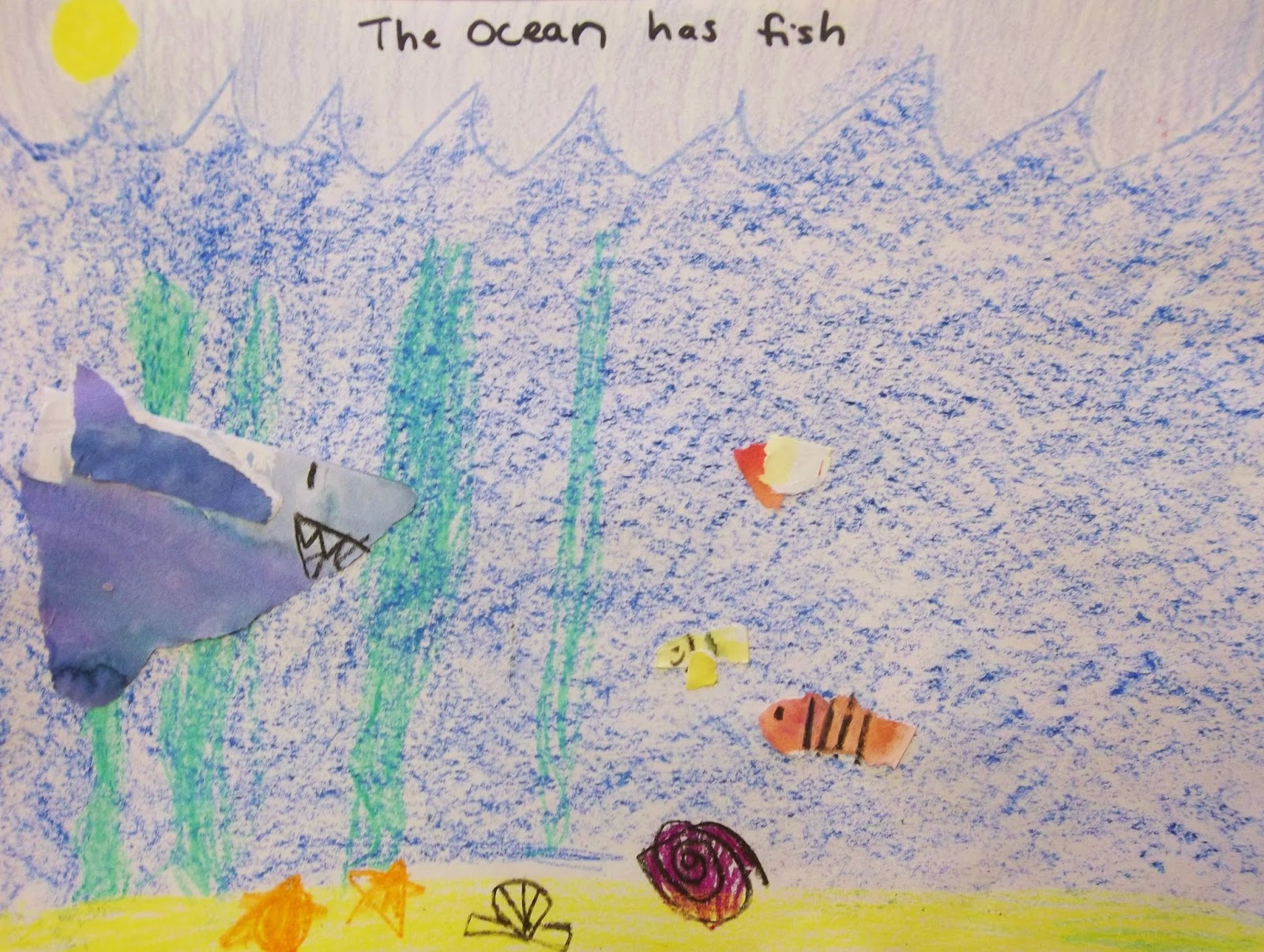
 With Kinders we learned about different habitats and landscape and drew a background picture for where our animals could live.
 Then we painted some textured paper ala Eric Carle after looking through his Animal Alphabet (hey literacy connection!). Finally we learned how to tear shapes out of paper to create animal shapes, making sure to choose an animal that would match our habitats.
 I asked students what was in their picture and wrote down their sentence. I love hearing their descriptions. I like to use titles or one sentence descriptors as an introduction to art writing- something very important to me.
 First graders started their "Art around the world" unit, and looked at Australian Aboriginal dot paintings for inspiration. We talked about what animals lived there and how they are very different than animals in other places because of how they developed on an island continent separate from other continents.
 They used an animal picture resource sheet for reference and chose which Austalian animal they wanted to paint. They then painted the interior of their animal shape a solid color.
 The next week I showed them a short animation of a dot painting and we talked about how the dots could create patterns or camouflage for an animal, or how the dots in the paintings could show how an animal moves or where it has been (tracks). The dots create a sense of movement.
 Seeing the video really helped them be more thoughtful about why they were making dots. These are much larger than the ones we did last year. I also asked them to come up with an interesting title for their work and I went around with a sharpie again to neatly write their title and name. I've had requests lately from teachers for names on the front so they can see whose art is whose when it's on the walls.
 Finally my 2nd graders have just completed their Oaxacan-inspired wood animal sculptures. We read "Dream Carver" by Diana Cohn, and then planned an imaginary animal to create.
 Then we assembled wood blocks and shapes to create an animal form. Above is a "Rabbit-Deer" and below is a peacock.
 We spent one class period on painting a base coat over the whole sculpture.
 Finally, we added feathers, googly eyes, and painted details to complete it. Students also wrote a short description by completing sentence starters: This is a_______. It lives in________. It's special because____. Sentence starters are great for prompting younger kids' writing about their work. Whereas older children can respond to a question. There's a certain skill to turning a question prompt into a response- my younger kids tend to think they have to copy the question and provide a one-word answer. NOPE! Complete Sentences please!!
More animals are on their way.... Spring is in the air.....

Wednesday, January 8, 2014

Happy New Year!

 I went back to school on Tuesday after an extra long Winter break (so great when Christmas is on a Wednesday!). Of course, we're suffering through the coldest weather I've ever known in my entire life... about 1/5 of our students were absent yesterday!
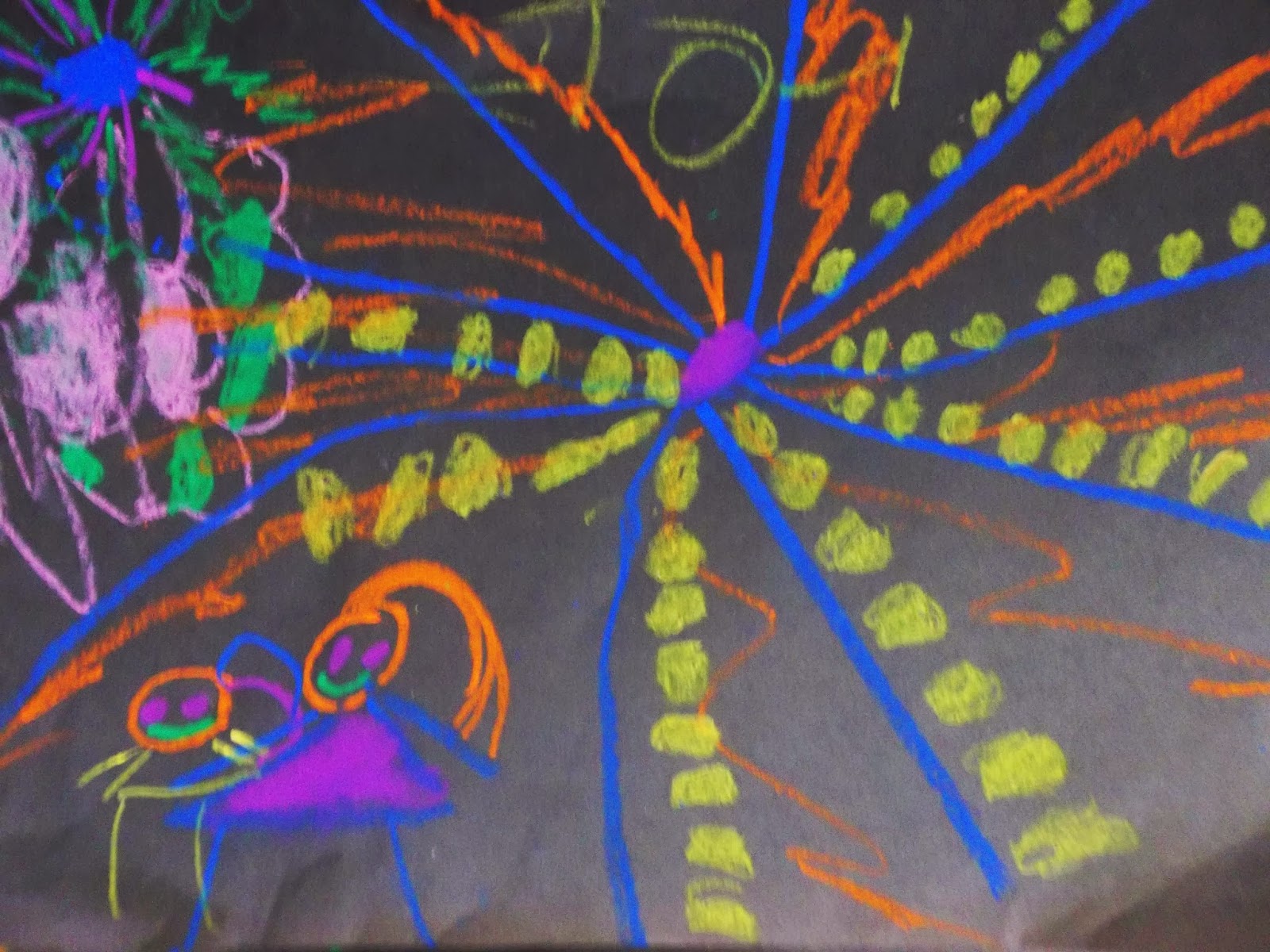
 With my remaining Kindergartners, we looked at the Firework art of Cai Guo-Qiang as well as some fireworks photographs I'd taken on New Year's Eve.We talked about the sounds, sizes, and colors of fireworks and even watched a short video of fireworks in reverse!
 We made hand motions to mimic the sound and expansion of a firework explosion, clap...and going out from the center in a radial motion.
 We used oil pastel on black paper, noting that you can't really see fireworks if they go off during the daytime. As students finished up I asked them to count how many they had drawn and to notice if they were big or small.
 At the end of class, each table group got to come up and make a fireworks show saying "POP!" for their small ones and "BOOM!" for their big ones. I really love this project... it's quick, fun, related to student experience, kinetic, auditory... the best!
I have to share this construction by one of my 4th grade boys. He had finished his stained glass project early, and had time for free choice (a 4th grade rarity). It seems appropriate for this Happy New Year post as it's an awesome Chinese-inspired dragon. I loved how he surrounded it with water diamonds.
I hope the rest of the school year continues as easily as the beginning has been. Happy New Year, everybody! Have a creative year blessed with highly engaged and well-behaved students! (We can dream, right?)

Sunday, December 15, 2013

Snowy days, medieval times, and still-lifes

December is speeding by, and I wanted to share what's been going on in My Blue Artroom between snow days, field trips, half days, and holiday concerts. Really it's a wonder I can get the kids to finish anything when I barely seem to see them!
 First graders were definitely able to relate to our snowy landscape project as it's been nothing but snow around here for the last week and a half. We watched  a clip from "The Snowman" as well- so there are some northern lights showing up in a few drawings.
 We tried to emphasize near and far through scale in these drawings. I just realized there was a penguin in the picture above! Another inspiration from the video I think. Isn't it funny how even kids who grow up in rowhomes with flat roofs still draw square houses with triangle roofs?
 I'm impressed with how detailed Santa's sleigh and reindeer are in this picture. I do not make projects specifically holiday related, but kids are excited about Santa right now.
 My 4th graders are learning about medieval art and did an illuminated letter in metal tooling with sharpie color. While half of one 4th grade class was out for choir rehearsal, I had a lovely group of 16 kids. The small size and roomy space allowed me time and energy to follow creative inspiration to add cardstock frames to their creations for them to embellish. It made a huge difference in how they turned out.
 It also allowed more room for personal expression.
 And more space for imaginative drawing. I love the dragon border repeated from the dragon in the metal below: If only all my classes could be just 16 kids- it was the most relaxing and creative day. They were being artists.
 Kindergartners are learning about genre, starting with still-life. we looked at some Matisse and Cezanne still-life images first. I asked them if any of their parents or they took pictures of food or things at home. It was startling how many of them had access to cameras or tablets for taking pictures. I REALLY wish I had technology in the art room like that. These are tech-literate KINDERGARTNERS!!!!!
 Since I don't have bowls and fruit in the art room, we used art room stuff to make a still-life instead. The kids built a little shape still-life for themselves and then drew each shape on their paper (NO tracing!! okay some tracing was going on.... but some kids needed that support).
Coloring skills have skyrocketed in Kindergarten in the past 2 months. I keep emphasizing "no scribbling- that's what 4-year-olds do and we're 5 and 6 years old!" They are taking it to heart and showing me how careful they can be. I love it! 

I have 3 1/2 more days to teach till Winter break!

Sunday, June 9, 2013

Riding Off into the Sunset

 This architecture/cityscape was the final project of the year for my 2nd graders. We looked at various kinds of architecture before doing a found object blueprint. The prints came out kind of sloppy, so we rolled it into a space review. These landscapes were way more successful than our landscape paintings back in January. Some students got really excited about the extra details they could add to their cities, but sadly my camera died before I could get pics of everyone's projects. Yeah- my constant picture taking and uploading for Artsonia has ruined the hinge that holds the SD card and battery in place, so now I can only take pictures while squeezing the little door closed for pressure on the battery...
My last day with kids was on Thursday last week. Now I've got a few days to pack up the room for the summer. I've got lots of willing helpers, so I put up a list of jobs on the board for kids to choose from. I said to them, "you can stay for 15 minutes, or to the end of your job, and if you finish you can stay and do another or go." I figured 15 minute windows would hold their attention, and if they got bored of a job they had an out. I didn't want to force anyone to stay or do something they didn't want to do, and they still got jobs that I wanted done. Win-Win for me and them!
I haven't had a chance to review the end-of-the-year surveys yet, but I'll soon post some of the comments kids made about art class this past year.
What has been very heartening and rewarding is hearing my older kids who are moving up to middle school say how much they'll miss me and how much they loved art this year. I met a lot of parents this past weekend at a community arts festival, and also heard feedback from them about what a good job I've done this year and how happy their kids are in art class. Art class is generally a happy place to be, but it's nice to know I've kept it that way. I met with my principal and signed my induction papers this week- I have officially made it through my first year of teaching!!! Hooray!

Saturday, February 23, 2013

3rd grade Pop-up Landscapes

3rd grade has just completed their landscape genre project which focused on background, middleground, and foreground. To make understanding of the different spaces very literal, I thought it would be fun to physically separate them and make a pop-up landscape. We started with a map to cover a foundation piece of chipboard, and used the roads and boundaries within the map to inspire a horizon line for the background of a landscape. Students then created a middleground layer from construction paper, and then foreground elements. To emphasize a sense of space, students were encouraged to draw things tiny in the background and large in the foreground. They were also challenged to make something happen in their landscapes like Grant Wood did in "The Midnight Ride of Paul Revere", one of the paintings we looked at for inspiration.
 We had a paper spring folding contest before assembling the layers. Photos don't really do justice to these pieces, because it flattens them out. In reality, these images really pop-out, and the small foreground pieces even quiver in the air currents or when jostled. Students had a choice of what kind of landscape to create. My original example showed a mountainscape, and so it was a popular choice. Although the range of animals included bears, rabbits, wolves, squirrels, and even monkeys.
 Seascapes were another very popular choice- probably because many of my students enjoy going down to the Jersey shore in the summer, and it's familiar. I can just imagine Ocean City in the boardwalk scene below, which includes a ferris wheel and cotton candy vendor. 
Another favorite landscape was the EXPLODING VOLCANO. About half my boys did a version like this, many of which included screaming villagers fleeing from the lava. (Could it be that they remember my Pompeii story from when we did mosaics? Dream on Art teacher)

At the end of the lesson I gave students a sheet of lined paper and some sentence starters on the board so that they could write a description. They had to give a big idea sentence: "My picture is about...." . Then supporting detail sentences: "In the background,....", "In the middleground,...", and "In the foreground,..." Finally they could conclude with an opinion about the project: "I thought this project....."
After writing, they glued the papers to the back of the project. I really like having them write about their work. It gives them extra writing practice and an opportunity to express themselves in multiple ways. Although they groan and protest ("But this is ART class!"), I tell them artists have to write ALL THE TIME and to get used to it. It was also one more way for me to assess their understanding of the key concepts of space and landscape. This lesson is definitely a keeper- all the other classes in higher and lower grades kept asking when they would get to do it!